NeuroScreen
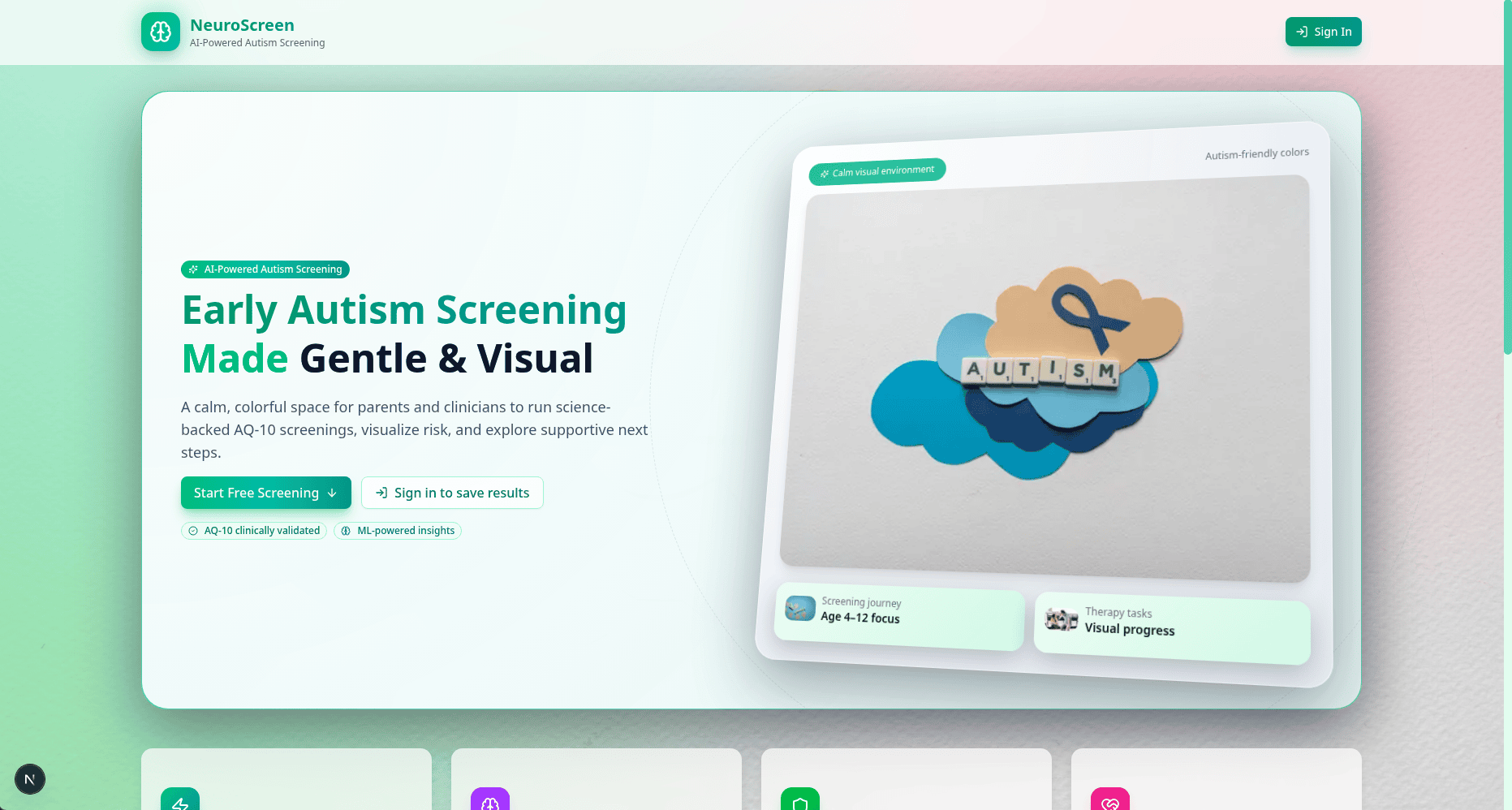
An AI-powered autism screening platform combining behavioral questionnaires with ML-based risk assessment, AI-assisted therapy recommendations, and interactive screening tools.
Overview
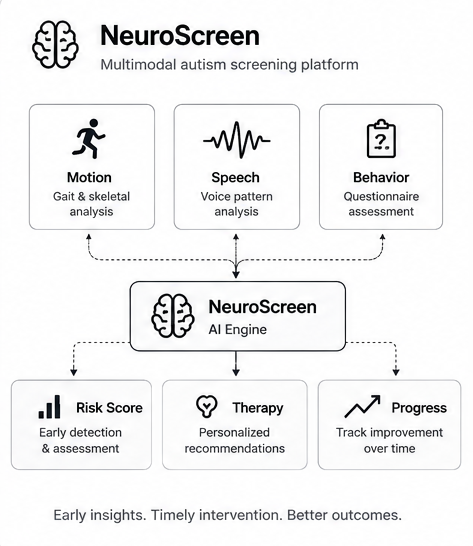
NeuroScreen is a multimodal autism screening platform. It brings together a behavioral questionnaire, skeletal motion analysis, AI-assisted recommendations, and progress tracking into a single modern web application.
Screenshots
Problem
Early intervention changes outcomes, yet specialist access involves long waitlists and families lack an immediate, trustworthy screening signal. Existing digital screening tools are largely single-signal and leave families without clear next steps.
Architecture
Solution
NeuroScreen layers multiple screening signals — a validated behavioral questionnaire and skeletal motion analysis through an ST-GCN model — to produce a risk assessment. AI-assisted therapy recommendations and progress tracking give families something actionable while they wait for a specialist.
Key Features
- Skeletal motion analysis using an ST-GCN model
- Behavioral screening questionnaire for autism risk assessment
- AI-assisted therapy recommendations
- Progress tracking for continuous monitoring
- Modern web interface built with Next.js and FastAPI
- Modular architecture supporting future speech-based screening
Technical Decisions
- ST-GCN for skeleton-based activity analysis — graph convolutions are a natural fit for body-joint topology.
- FastAPI for the ML backend so model inference, scheduling, and report generation share one service boundary.
- A modular pipeline design so speech analysis can be added as a new stage without reworking existing screening flows.
- PostgreSQL for structured screening records and longitudinal progress data.
Lessons Learned
- Screening is a signal, not a diagnosis. The interface and language must keep clinicians firmly in the loop.
- A multimodal system is only as honest as its weakest evaluated stage — publishing only final-model metrics matters.
- Designing for future stages (like speech) from the start keeps the architecture from ossifying.
Future Roadmap
- Publish evaluation metrics from the final ST-GCN model
- Speech-based screening as an additional pipeline stage (planned)
- Longitudinal progress analytics for clinicians
- Expand to additional behavioral instruments