AI Service Orchestrator
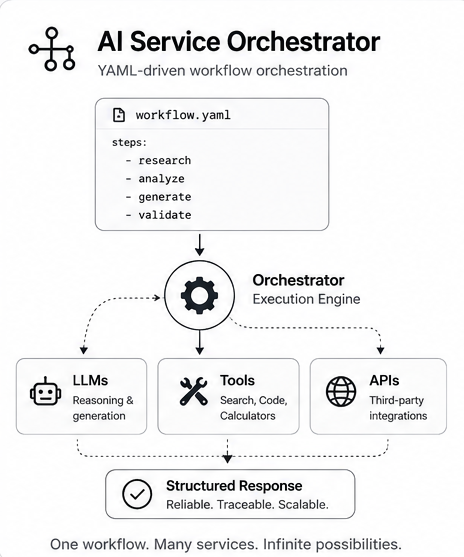
A declarative AI workflow orchestration engine that executes YAML-defined multi-step AI workflows, enabling teams to chain AI services into autonomous agents without writing orchestration code.
Overview
AI Service Orchestrator is a control plane for AI workflows. Teams define multi-step pipelines as YAML and the engine handles execution, retries, branching, and parallelism — no orchestration glue code required.
Problem
Composing AI services means writing custom code for sequencing, error handling, and parallelization. Every new pipeline duplicates that glue, and the logic is hidden inside application code instead of being visible and versionable.
Architecture
Solution
Workflows are declared in YAML and executed by a Spring Boot engine. Steps run sequentially or in parallel, can branch, and retry on failure. Providers are abstracted behind OpenAPI-compatible interfaces, so the same workflow can target different AI backends without modification.
Key Features
- Declarative YAML-based AI workflow definition
- Execution engine for multi-step AI pipelines
- Provider abstraction through OpenAPI-compatible interfaces
- Support for branching, retries, and parallel execution
- Extensible architecture for integrating additional AI providers
- No-code approach to agent orchestration
Technical Decisions
- YAML as the workflow DSL — declarative, diffable, and reviewable in pull requests.
- DAG execution model so dependencies are explicit and parallelism is safe by construction.
- Provider abstraction behind a stable interface so adding a model vendor is additive rather than invasive.
- Retries and branching as first-class workflow primitives rather than code concerns.
Lessons Learned
- Workflow engines are about making the common path boring and the exceptional path explicit.
- A clean provider interface is the difference between an integration and a platform.
- Reproducibility is a side effect of declarative definitions — a workflow is also a record of what ran.
Future Roadmap
- Richer step control: cancellation and timeouts as workflow primitives
- Workflow observability and step-level tracing
- Additional built-in provider adapters
- A visual workflow editor